
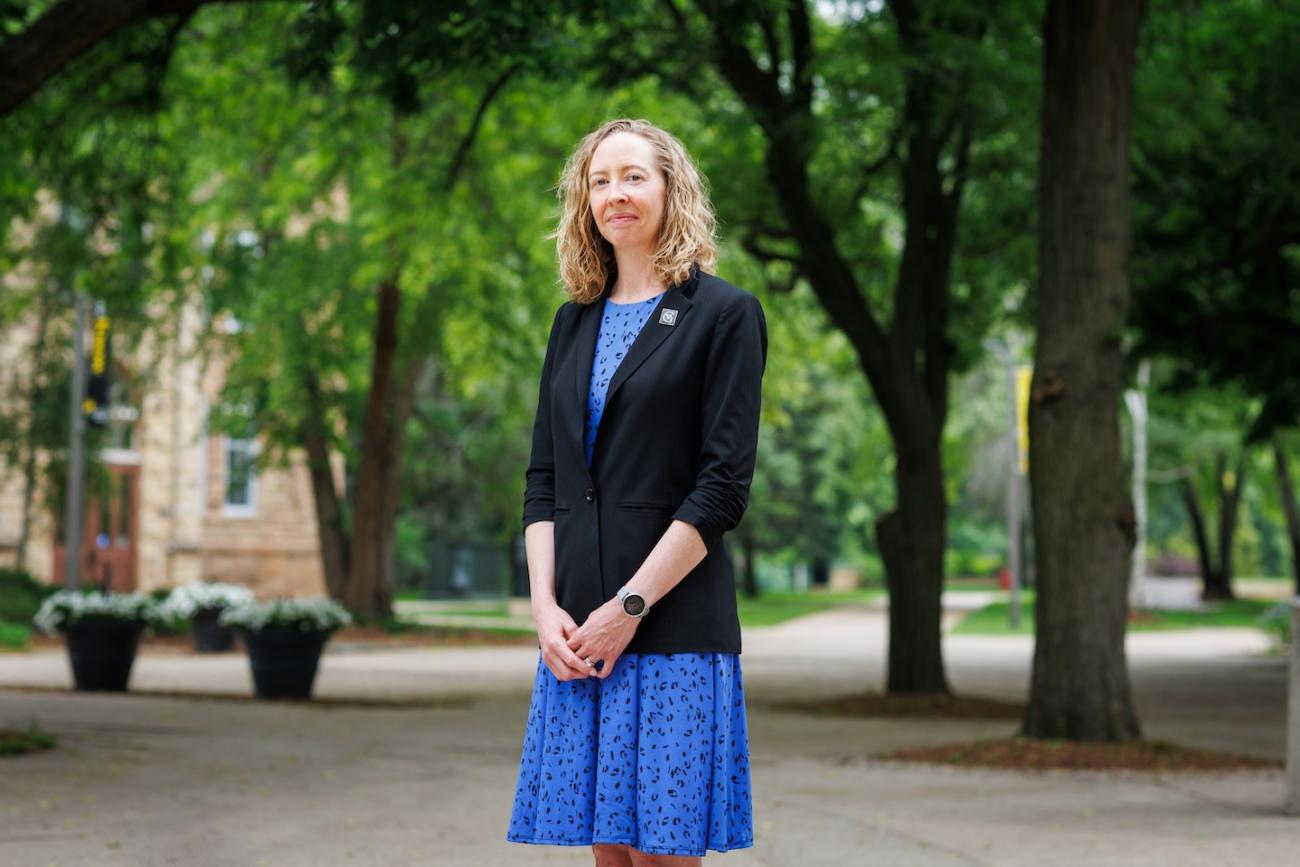
“Consider the turtle,” she says. It’s an animal, a cheesecake, even a ninja. “Ask AI what a turtle is. If you don’t know there are multiple types of ‘turtles,’ you might be really misinformed about a turtle.”
Now, replace turtle with truth, in all its forms, fallacies, and foibles.
It’s good to have a rhetorician as your college’s academic provost in an age when the distribution of information is both vast and segmented, when messages are meant to inflame our emotions in order to sustain our attention, where the truth (as comedian Stephen Colbert satirized) is often more “truthiness” than truth.
“As a discipline, rhetoricians look closely at symbols and language and how we make meaning of them in our everyday lives,” Conners says. In her research, she focuses on arguments and deliberation in public spaces. In her classrooms, “I see teaching as a rhetorical project: understand your audience, adapt to that audience, help them move and grow with you.”
Spoken like a true Gustavus prof. “At Gustavus, we’ve always had an innovative mentality—that belief that teaching is something done with students rather than at students.” Back in 2010, when she interviewed here after earning a master’s degree and PhD from University of Wisconsin- Madison (and a BA from liberal arts college Bates in Maine), “I knew Gustavus as a place that doesn’t rest on its laurels but on its values.”
In today’s classrooms, she says, “the challenges are different, and they are coming rapid fire. All the noise in the world? All this difference? Students bring it into the classroom. I’m proud that our faculty continue to push and innovate through the fog.”
Whatever they’re doing, it’s working. “We know that when our students go to conferences they are shining stars, when they do internships, those employers want to see more Gustavus students. When they are hired, employers say, ‘Yes. I know what this person is bringing because they’re a Gustie.”
The rhetorician and forefather of liberal arts education Aristotle said, “It is the mark of an educated mind to be able to entertain a thought without accepting it.” It’s called critical thinking, and it’s a bit lost these days when everything everywhere is available all at once on millions of channels and extremely high volume, and just sitting there in your pocket waiting for you to look at it and ask for the truth about something.
But now is exactly when we need it most. “Critical thinking is critical work in our democracy,” Conners says. “And it’s something my colleagues and I live out every day with our students.”