

“I was always asking questions about what it means to exist.”
As a kid, Gill attended what he describes as his uncle’s “Pentecostal-ish” church on Chicago’s South Side. His mother also had a shelf of philosophy books; he remembers paging through Plato’s Apology of Socrates at age seven. Naturally, he had some questions. “This God is all powerful? This God knows everything? Then what is God’s origin?”
He thought about becoming a pastor. Then came hip-hop.
His first cassette was MC Hammer’s Grammy-winning Please Hammer, Don’t Hurt ’Em. He then discovered Chicago’s underground rap scene. “I started to hear stuff my mother wouldn’t want me to,” he says. He heard Christian hip-hop group Tunnel Rats and thought, “You can battle people lyrically and still be a Christian?” Then, of course, Wu-Tang.
Hip-hop was a framework for so many of his evolving questions, encompassing the metaphysical, the political, and the artistic. “I saw hip-hop as a culture, a practice, a way of life, a religion,” he says.
At Judson University in Illinois, he majored in biblical studies and took philosophy classes. He earned a master’s in philosophy at McCormick Theological Seminary while emceeing in Chicago. He earned a master’s in theology at the Lutheran School of Theology in Chicago, then on to California’s Claremont Colleges for a master’s and PhD in philosophy of religion. His journey, “is an academic quest that has skin in the religion game.”
And the hip-hop game too. “In art there is something transcendent that happens that can’t fully be explained. I am playing with that.”
His students play with that too, in his course, Philosophy of Battle Rap, which explores the origins of hip-hop culture and what battle rap can tell us about philosophy, artistic expression, public speaking, rhetorical persuasion, and intellectual inquisition. The popularity of the course has overwhelmed him. “It’s been transformative to students. They don’t know hip-hop is deep, that it extends around the world, that it’s an ancient way of becoming that is not forced on you by nations, governments.” In the course, students examine their inner essence and practice their sense of agency. “It gives them the power to say, ‘I can create my own life.’”
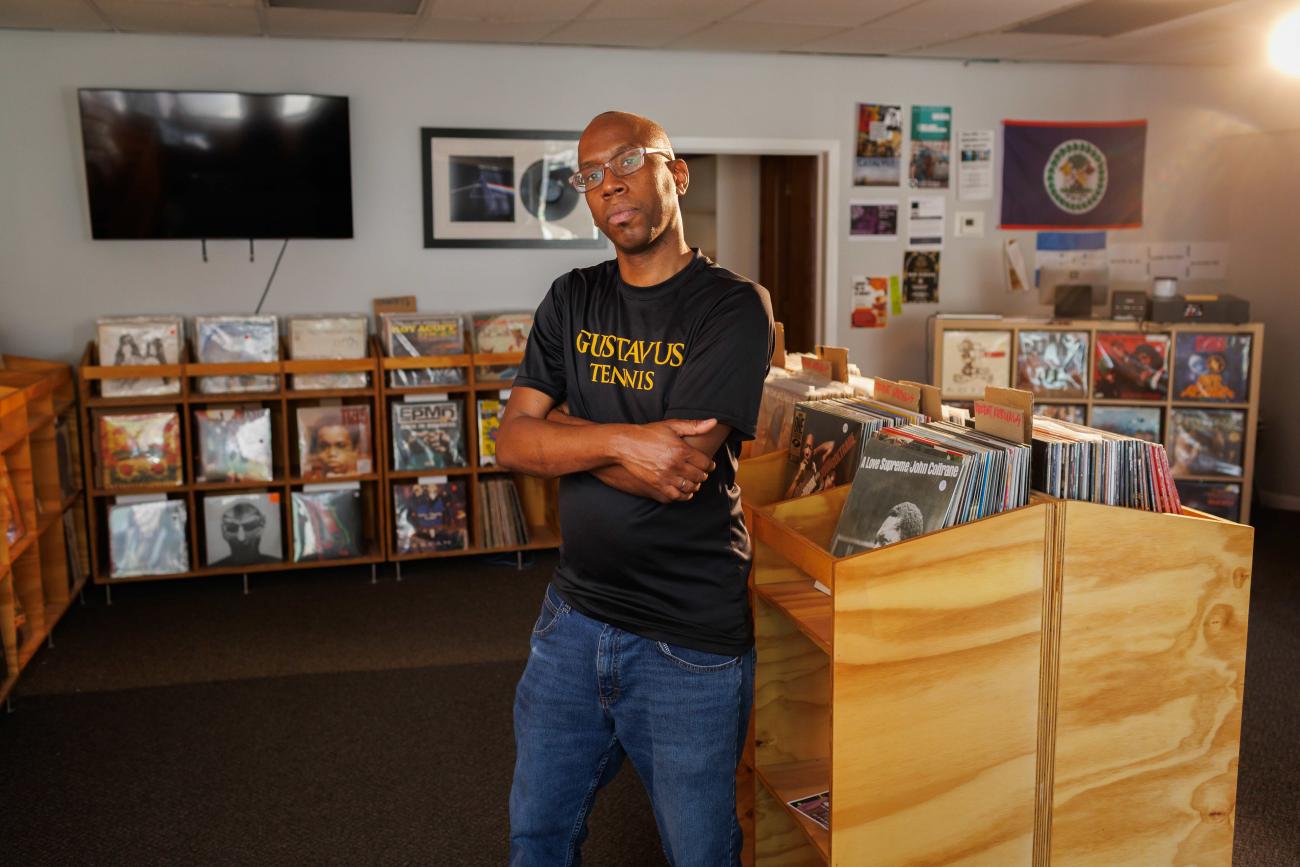
When not teaching, Gill is an emcee with his own hip hop crew, Tomorrow Kings, and proprietor of Aesthetic Religion Recordings and Texts in downtown Saint Peter, a gathering and performance space and record shop. His is a liberal arts life made smartly and artfully with others. “I believe that change happens on communal energy when people are impassioned about what they love.”