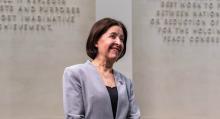

The Schaefer Gallery serves as a vibrant platform for the Gustavus Art Department to promote contemporary art, balancing student showcases with exhibitions from established artists to inspire campus and local communities. For its latest exhibition, the gallery presents the transformative work of artist Sobia Ahmad.
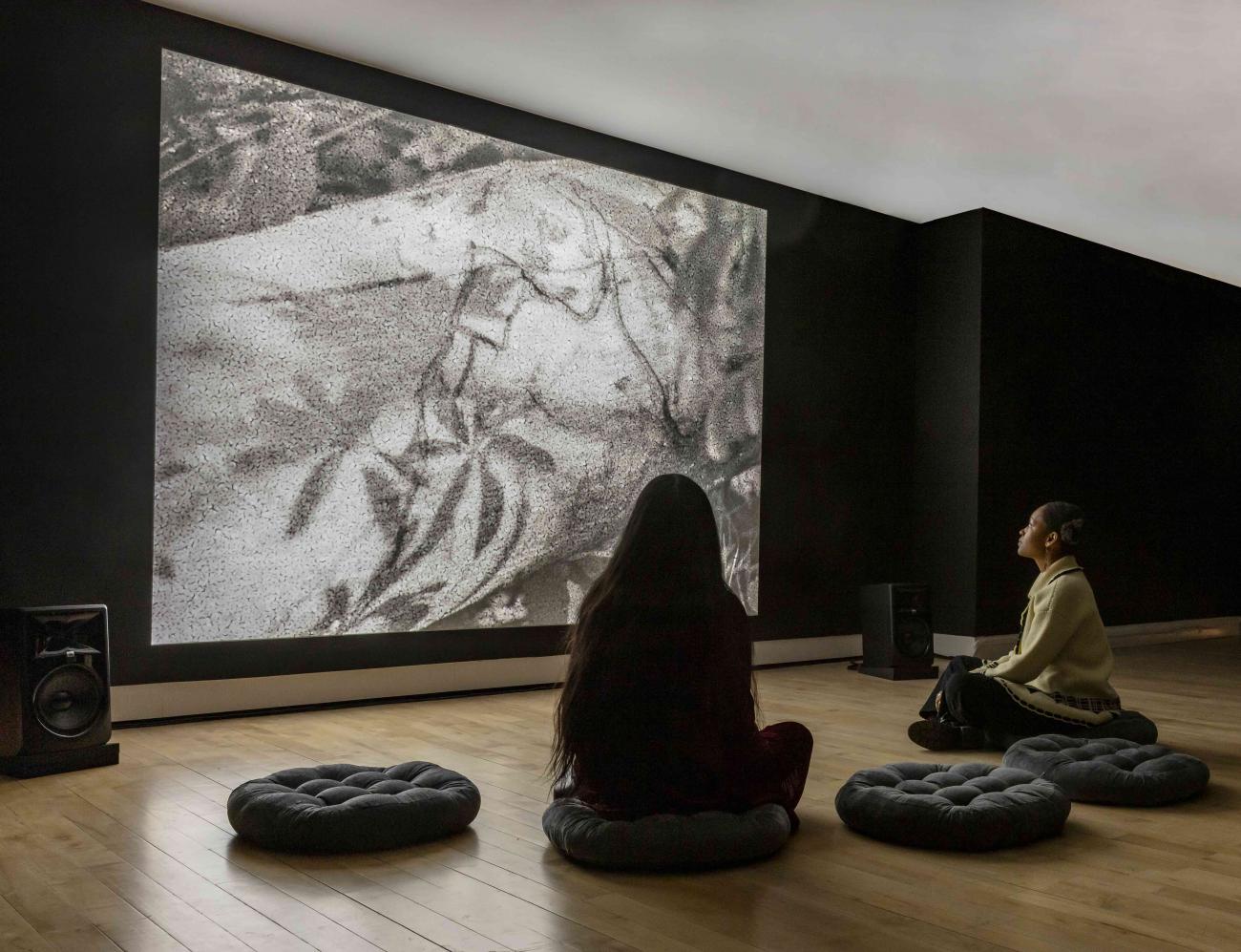
Exhibitions Coordinator Audrey Power Theisen shares that Ahmad's creative process fundamentally reimagines the gallery itself, "To me, art is about taking things we recognize and making them new, different, unrecognizable. Sobia's work is exciting to me, in part, because she's found ways to reimagine the gallery and has even produced works that respond to some of its features, like the wall of windows."
By weaving together diverse themes, the exhibition invites visitors to slow down and re-evaluate their everyday surroundings. "This show combines art, ecology, and spirituality-- there's a little something for everyone to relate to and enjoy," notes Power Theisen. "I hope this exhibition encourages students to be curious, creative, and passionate. I hope it makes viewers stop and look closer, and maybe wonder what else is unseen around them."
“As One They Quake” runs from September 10 until November 13. Sobia Ahmad will be on campus for an artist talk and opening reception on October 14, from 5-7 p.m. in the Lecture Hall.
Read on for our full conversation with Sobia Ahmad as she delves into her process, inspirations, and her installation at Schaefer Gallery.
Can you talk a little bit about "As One They Quake" for folks who may not be familiar with your work?
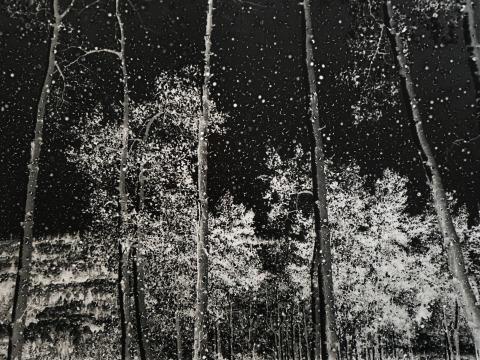
"As One They Quake" includes a long-term body of work that began with my encounters with Pando, an 80,000 year old aspen forest in Fishlake National Forest in south-central Utah. Though it appears to be thousands of individual trees, Pando is actually one organism connected by a single root system spanning over a hundred acres. It is a “forest of One.” I became fascinated by this tension between what we see, multiplicity, and what exists beneath the surface, an immense interconnected whole.
Since 2022, I’ve spent two seasons at Pando developing a body of photographs and a 16mm film made in collaboration with anthropologist and filmmaker Benny Shaffer. During these trips, we built relationships and gathered stories: a scientist who has dedicated his life to studying Pando’s halted regeneration; environmental advocates fighting for its protection; a local woman who shared a tale of two lovers buried beneath a heart-shaped grove; and a local legend about branch scars on the tree trunks that resemble eyes. The legend describes this “forest of eyes” as “One Big Eye that gazes back at humankind.”
These encounters and research led me to develop a parable that interweaves scientific, folkloric, and mystical ways of relating to Pando. What began as an effort to photograph and film a place became a way to think about Oneness, and the relationships between ecology, spirituality, and ways of knowing that extend beyond what can be immediately seen or measured.
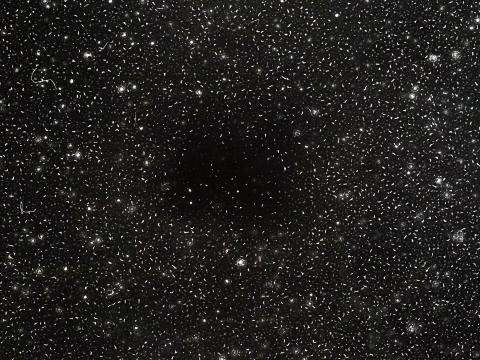
The exhibition brings together my hand-processed 16mm film alongside gelatin silver photographs made through ongoing experiments with handmade and biodegradable photographic processes. Working with materials such as coffee, plants, salt, washing soda, and other everyday ingredients, I develop film and photographs at home in the kitchen sink. These processes embrace uncertainty and chance, allowing the materials themselves to become collaborators in making the image.
The title "As One They Quake" draws from the quaking of aspen leaves, whose individual movements gather into a collective trembling across the forest. For me, this becomes a metaphor for Oneness where seemingly separate beings responding to the same forces, deeply entangled with one another and the larger systems we inhabit.
One of the things that I loved in your artist statement was being intentional in choosing processes that are purposely slow and encourage patience. As so much these days is centered on optimization and quickness, why is it so important to you to stay grounded in this process?
For me, slowness creates space for a different kind of attention. So much of contemporary life encourages us to move quickly toward an outcome, to solve, produce, and move on. I’m interested in what becomes possible when I resist that impulse and allow a process to unfold without knowing exactly where it will lead.
Working with analog film already requires a certain amount of patience, and my handmade photochemical processes slow things down even further. I might spend hours testing a particular plant for a recipe, only to get an unexpected result.
Sometimes the image fails completely, and sometimes that failure opens up a direction I could not have anticipated, like the way my homemade developers react with the film surface, leaving artifacts that resemble something microscopic or cosmic. I’ve come to value that uncertainty because it asks me to pay closer attention rather than trying to control everything. Slowness is also connected to the spiritual dimension of my work. I think of making as a form of listening or seeking. It requires me to be present with materials, with place, and with what is unfolding in my art practice. I’m not interested in slowness simply for the sake of making something slowly; I’m interested in what a slower process allows me to notice. It gives me room to encounter relationships that might otherwise be overlooked.
What excites you about having your exhibition hosted at Gustavus?
College is such an important time for asking questions, reconsidering assumptions, and encountering ways of thinking that may be different from what you’ve previously known.
I’m especially interested in the conversations that might emerge with students around ecology, spirituality, and our relationships with the more-than-human world. Pando gives us a very tangible way into some of these questions: What does it mean to think of a forest not as a collection of individual trees, but as one living organism? How might that shift the way we understand ideas like individuality, interdependence, or time?
I also hope students feel invited to think about the process, not just what an image communicates, but how it came into being. The works are made through experimentation, repetition, failure, and patience, and I think those are things that can resonate beyond artmaking. There’s something valuable about being reminded that not everything has to be optimized or immediately resolved. I’m excited to see what questions students bring to the work and what new connections they make with it.
Have a story you'd like to share? Email editor@gustavus.edu.