
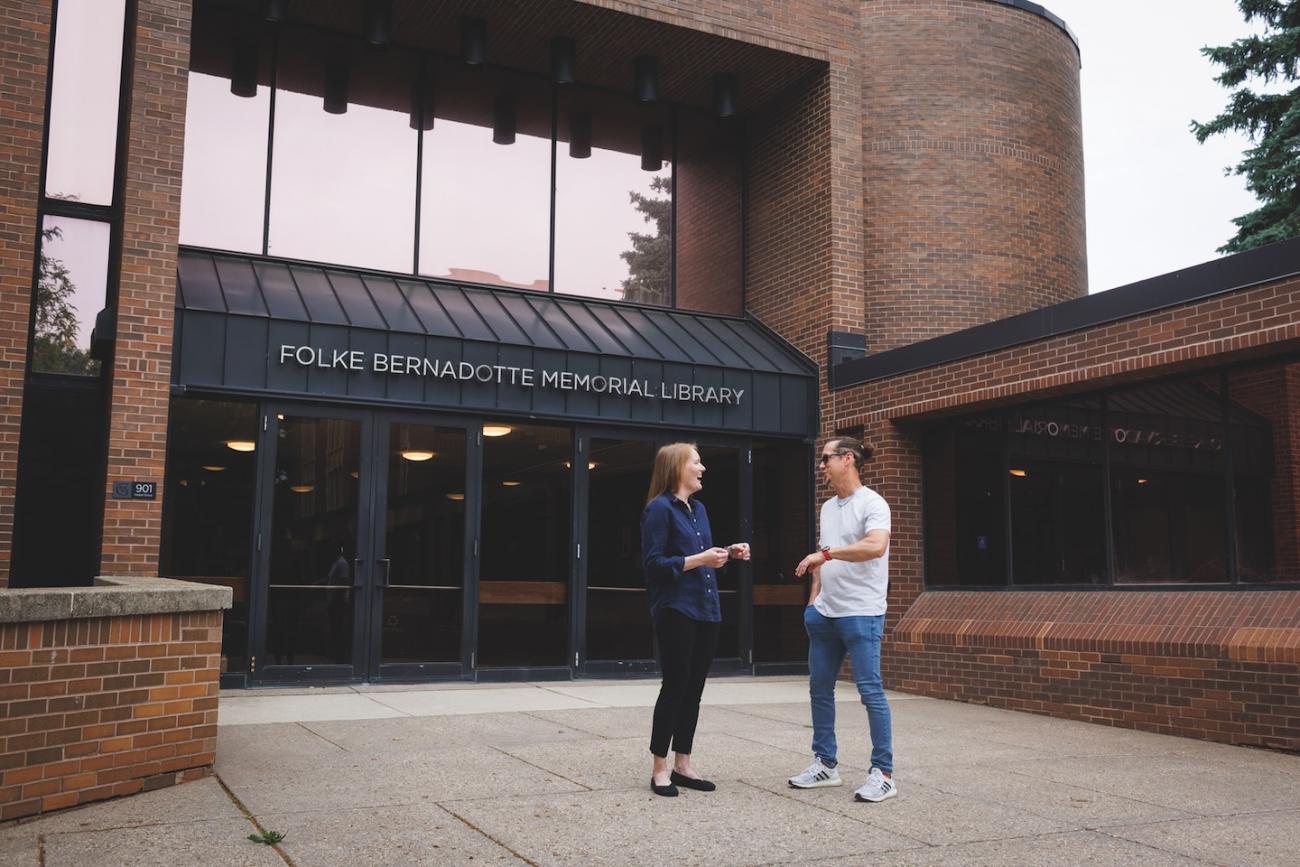
Gustavus Magazine: How did you both come into this work?
Salivia: We are an outgrowth of a team focused on AI and curriculum, which came up with guiding principles around artificial intelligence usage that were endorsed by the Student Senate, the Faculty Senate, and college leadership. Because everything we do will be obsolete very soon, this will be a long-standing community. Our charge this year is to help faculty navigate the intersection of generative AI and liberal arts pedagogy.
Flynn: One of my main responsibilities on campus is to teach students to be information citizens. AI has turned information on its head. As AI Fellows, we are asking big ethical questions about it. Who created this? How? Whose property is it? How do we use it ethically?
Salivia: These are questions that have been asked for a long time. The distinction today is the speed at which AI is evolving. We don’t have time to adapt to all the changes.
Gustavus Magazine: What are you recommending specifically to faculty about AI and its use in the classroom?
Salivia: Literacy and pedagogical recommendations. We want faculty to be transparent with each other and with students about AI usage. We’re also providing literacy into what AI is and is not.
Flynn: That’s what’s grounded our work. Regardless of how people are or are not integrating AI into their classes, those decisions should be made with a foundational knowledge of what AI is. We feel strongly everyone on this campus should be AI literate, including asking the larger ethical questions. That’s rooted in the liberal arts. We’re also offering learning modules and syllabus guidance to faculty, with options for multiple levels of AI engagement.
Salivia: None of it is tailored to a specific subject matter. We invite faculty to be part of the conversation and provide their own research and practices so other faculty can benefit.
Flynn: There is a deep ethos of care here among faculty for students’ learning and for society. That was really heartening. Some of the things we talk about are really difficult—the environmental impacts of AI, the labor that is replaced. Despite that, I feel a sense of solidarity with our faculty. There is a shared purpose in making sure our students are prepared and have agency to shape what this technology means for them personally and professionally. And I think that is unique to Gustavus.
Salivia: It was very important to listen to students. They are concerned, even more than faculty is. When I presented the principles to Student Senate, our message was that that we’re not adopting it, we’re adapting it to our own uses and needs. Technologies in general are not deterministic. And there is a lot of misinformation. People must understand what AI is and is not. Then our students can mold it. That’s the heart of our work. AI is here to stay. Does it have to be a world where “the robot overlords” take over? No. How it molds and impacts society is up to us. That is the heart of our work. And I think Gustavus is ahead of the curve on these conversations.
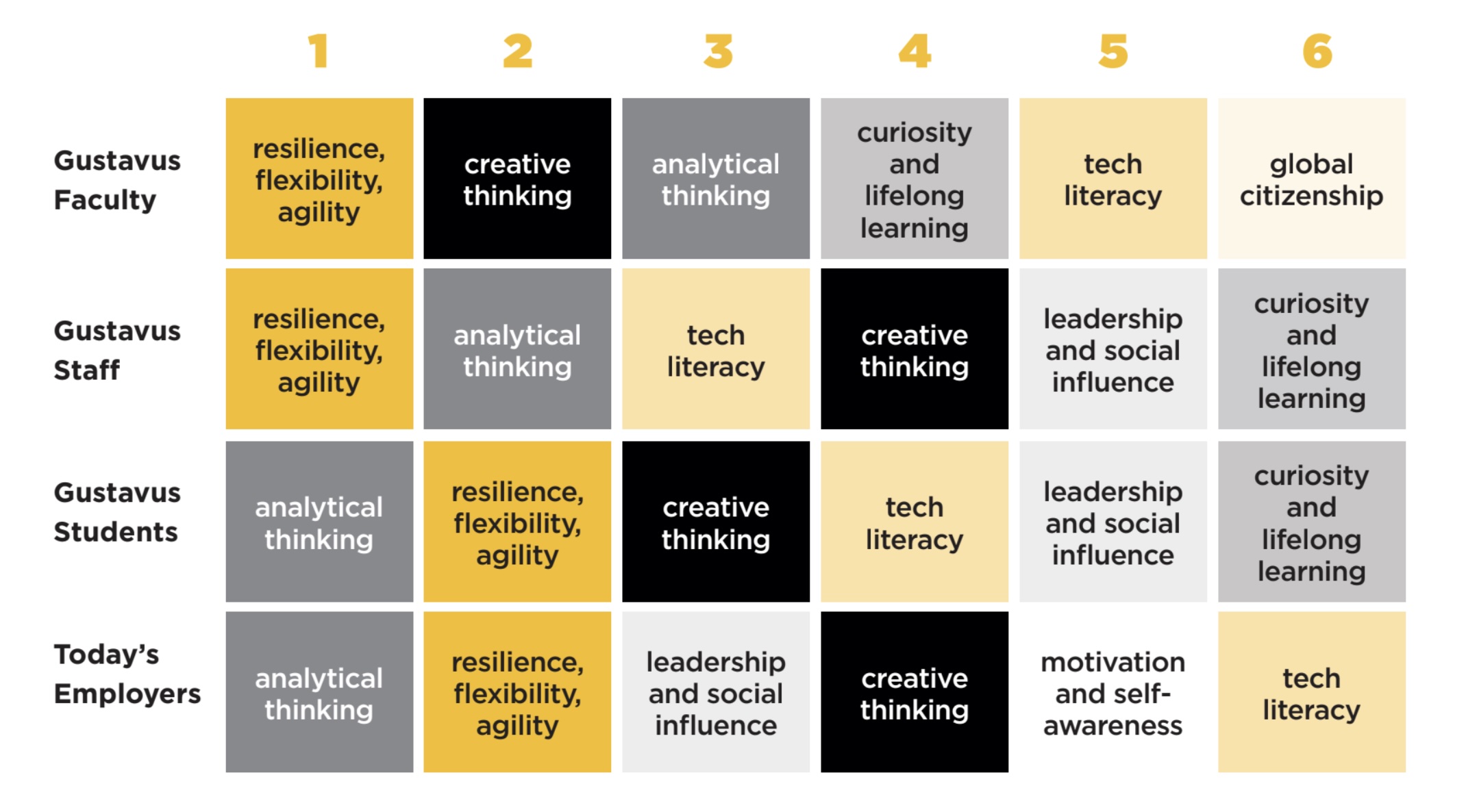
WHAT DO TODAY’S EMPLOYERS WANT? What today’s Gusties are taught.
FOCUS ON A BROAD BASE An analysis of more than 1,000 occupations published in Harvard Business Review in 2025 found that having a broad base of foundational skills beat specialized skills when it comes to making job transitions. (Those foundational skills: reading comprehension, basic math, strong ability to problem-solve, clear communication styles, collaboration, and adaptability.) And workers with a broad foundational base proved more resilient to job market changes. Plus, the study notes, jobs that blend cognitive ability and social skill have the highest salaries.
CONSIDER THE DATA The World Economic Forum surveyed employers representing 22 industry clusters. The Gustavus Humanities Endowment and the Center for Career Development surveyed students, faculty, and staff on professional skills and careers. Turns out, “the AI-proof skills employers are looking for are skills humanities students are well trained in,” says Yurie Hong, Humanities Endowment coordinator and classics professor.
Here are the top six skills we all agree we’ll need in the next five years.