
Gusties who’ve studied away—during a music tour, a semester abroad, an internship, or a research trip—know how it transforms you. New experiences shifted your perspective. Classmate bonding had you laughing (and crying). You came back changed. You’ve never forgotten it.
Now imagine your study away on turbo, with pre- and post-preparation to create an even richer experience. For today’s Gustavus students, study away hits different. It extends learning beyond the flight there and the flight home.
As part of the Gustavus Signature Experience, new curriculum now intentionally leads students to articulate what’s happening externally in the world they encounter as well as internally in themselves, so they can express it to future employers. Says Christine Diaz- Higgins, director of International and Cultural Education, “Study away at Gustavus is more than seeing a new place and thinking about what you can get out of it as a tourist. It’s about history, culture, and a new way of seeing. It’s about thinking deeper.”
Anyone can have an experience. Then, there’s experiential learning.
—Christine Diaz-Higgins, director of International and Cultural Education
This past academic year, Diaz and three faculty members with experience in intercultural education created curriculum to reshape Study Away experiences. Students now receive credit for the experience plus pre-departure and re-entry coursework. Assignments, discussions, and activities before and after the study away focus on understanding cultural differences, social and political systems, and societal inequalities. The curriculum also helps students talk about their study away in a professional setting.
“Most students need guidance to develop intercultural competency skills,” says exercise physiology professor Stephanie Jensen Otto ’00, who has led multiple international study away courses and who worked on the new curriculum. “Students need permission to admit they carry some biases and a safe space to process how that may influence their experience while away.”
What we are doing is helping faculty implement cultural competency [skills] development … then helping students understand that these are and have always been valuable to employers.
—Stephanie Jensen Otto ’00, exercise physiology professor
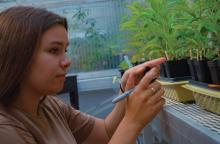
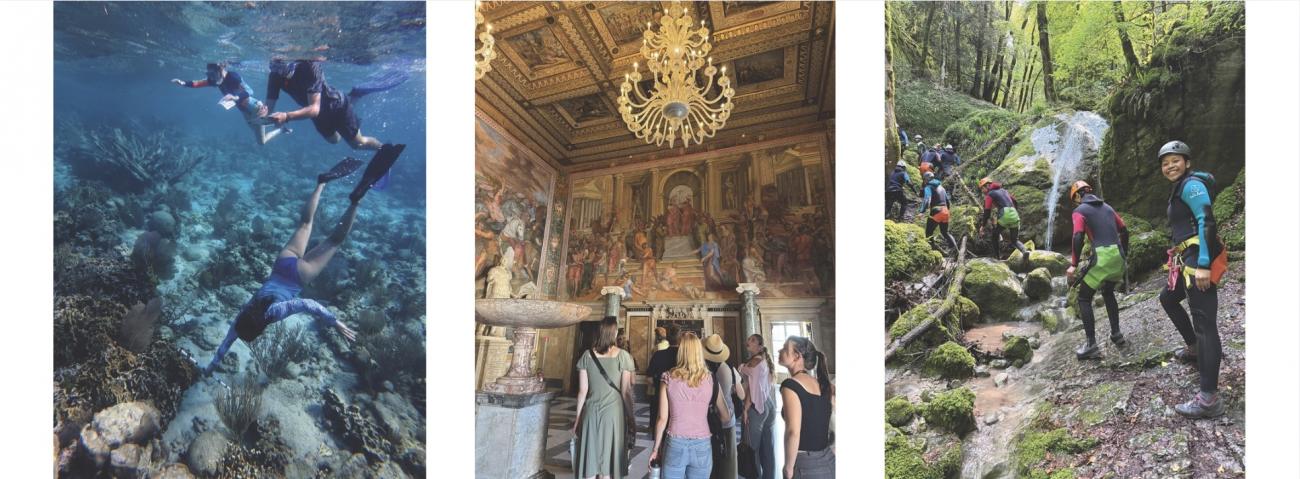
“SigX over May allowed us to engage the human side of conservation as a matter of justice,” says biology professor Jon Grinnell who led the course “Coral Reefs, Climate Change, and Conservation in Belize” with fellow biology professor Amy Kochsiek. In the course, which included two weeks of reef work and one of rain forest work, students explored “how local people rely on the reef and rainforest for their livelihoods, asking tough questions about causes and consequences, and hearing how the changing environment affects their lives.”
“What we are doing is helping faculty implement cultural competency [skills] development within their courses and then helping students understand that these are and have always been valuable to employers,” says Otto. Says Diaz-Higgins, “As a Gustavus Signature Experience, this is about students seeing studying away as relevant and advantageous professionally for the next chapter of their work and life.”
Travel Like Today’s Gustie Student
Study away at Gustavus is about more than being a tourist. It’s about framing the experience as holistic growth by asking deep questions as you go about your journey. Try it yourself before, during, and after you go somewhere new, particularly outside the U.S. Ask yourself some of the questions a Signature Experience study away would require you to:
Q Who’s here? Who do you see in this space? Who isn’t in this space? How is this different in the United States? Why?
Q How is this place different than your own home place? Why?
Q How is this different than what I am used to? Why?
Q What can I learn from this? What do I need to know more about?
Q How has this experienced changed me?