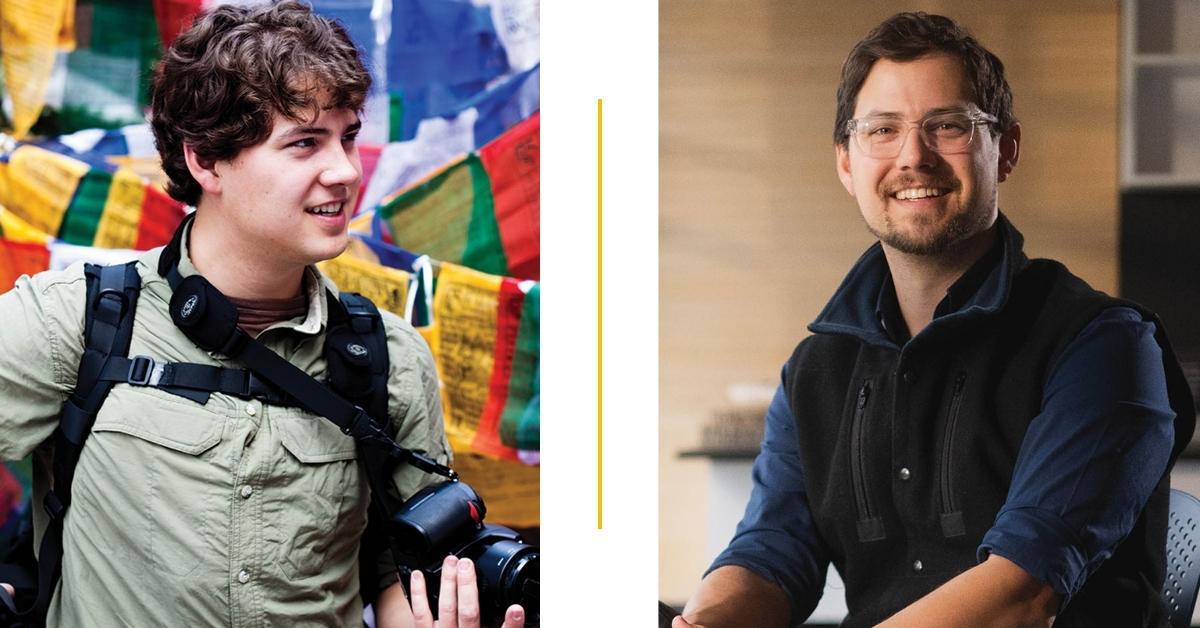
While canoeing through Canada when he was 17, Messenger was mauled by a 600-pound grizzly bear. The encounter—with a bite that just missed his femoral artery—lasted less than a minute. It has rippled through the rest of his life.
Gustavus gave him the skills to turn his survival into a story.
He’d long been obsessed with wilderness photography and off -the-grid travel, drawn to the boundary between humans and the wild. He declared a Studio Art major to develop his fi eld photography chops, and an English minor to hone his writing. He found new ways to explore on the page and out in nature through the study of a fi ne art and through the humanities. “One of the things I remember from my time at Gustavus is this idea about capitalizing on creative energy. I would just blitz through, write down as much as I could no matter how good it was, knowing I would come back to it,” he says. “I was also transcribing my journals from Canada.” It would become the bones of a book.
In the meantime, he took as many classes as he could in the subjects that interested him, photographed for The Gustavian Weekly, and set his sights on photojournalism. After graduation, he worked for National Geographic photographer Jim Brandenburg, the much-celebrated documentarian and advocate of Minnesota’s 2010 wild spaces.
Messenger has since handled marketing and communication in healthcare, higher education, and outdoor companies. But becoming an author always stayed in his sights. “It was a slow build to return to the book. But when I was ready to work on it, I had the tools I needed.” Almost fifteen years after arriving on the Hill, his memoir of that near-fatal grizzly encounter, The Twenty-Ninth Day, became a Wall Street Journal bestseller and a Minnesota Book Award finalist. His first novel, The Ice on the Lake, inspired by his time as a Duluth-based wilderness first responder and EMT with the St. Louis County Rescue Squad, was released in March of 2026.
Photography is instant, captured in real time. Writing books is a long game, captured through reflection and perseverance. He continues to explore wild and human stories through both. “Coming back to my apartment and giving myself space—I still do that,” he says, just like he did when he was a student living in Southwest Hall.